Holiday giant Tui is closing 166 high street stores in the UK and the Republic of Ireland, the UK's biggest tour operator has announced.
The decision was made following changes in customer behaviour as a result of the pandemic, the firm said in a statement, with the Anglo-German company calling COVID-19 the 'greatest crisis' the airline industry has ever faced.
Tui said that it would seek to move 70 per cent of the 900 staff affected by the closures to homeworking sales and services roles, and it would aim to relocate other employees in the remaining high street stores.
It announced it would cut 8,000 roles worldwide after posting losses of £747million in 2020 compared to £255million in the same period last year.
The announcement comes after Tui cancelled all flights to mainland Spain up to and including August 9 after the government struck Spain off the UK's list of safe destinations amid warnings 'no travel is risk-free'.
The timing of the shock U-turn has sparked widespread fury within the airline industry amid fears it will be the 'final nail in the coffin' for some tourism firms.
The global airline industry has been hammered by the impact of coronavirus, with the huge slump in demand for international travel leading to thousands of planes being grounded and staff numbers slashed.
In statement released today, Tui's UK and Ireland managing director Andrew Flintham said: 'We want to be in the best position to provide excellent customer service, whether it's in a high street store, over the telephone or online, and will continue to put the customer at the heart of what we do.
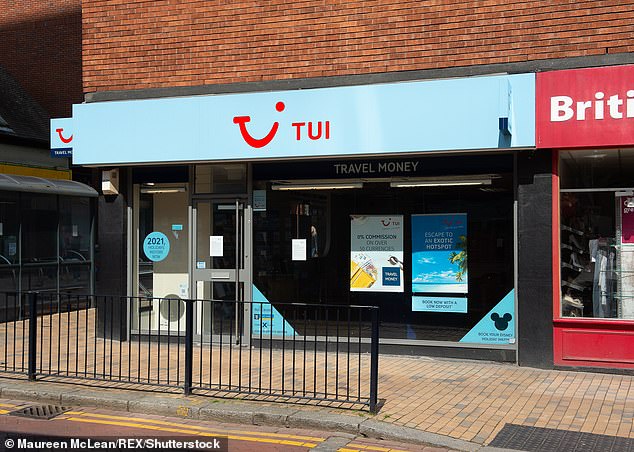
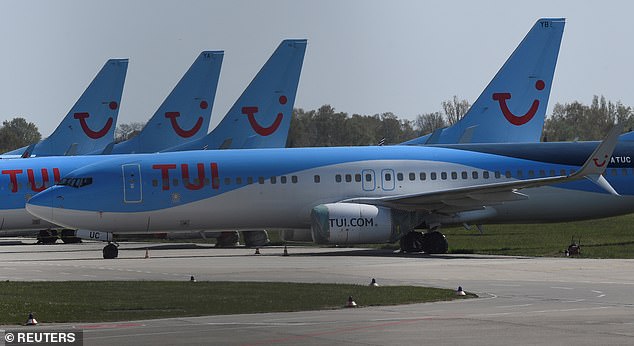
Holiday giant Tui is to close 166 high street stores in the UK and the Republic of Ireland , the UK's biggest tour operator has announced
The decision was made following changes in customer behaviour as a result of the pandemic, the firm said in a statement, with the Anglo-German company calling COVID-19 the 'greatest crisis' the airline and travel industry has ever faced
How coronavirus, travel bans and lockdowns have wreaked havoc on the travel industry
This week Ryanair revealed losses of £168million during the pandemic but insisted it will continue flying to Spain after UK tourists were told not to travel there.
The low-cost airline, like its competitors, was forced to ground its fleet as COVID-19 wreaked havoc on timetables with travel bans and lockdowns introduced worldwide.
Ryanair said it suffered the 'most challenging' quarter in its 35-year history after carrying 500,000 passengers from April to June compared with 41.9million in the same period last year. Its share price fell 8 per cent in early trading this morning.
Meanwhile British Airways faced an 'immediate' strike threat from union bosses over job cuts amid fears over further travel chaos to families trying to plan a holiday abroad.
Unite leader Len McCluskey claimed BA chief executive Alex Cruz had 'published a timetable to fire and rehire thousands of your workforce on August 7'.
Mr McCluskey also told how MPs and newspapers alike have condemned the actions of the Spanish boss, adding: 'Perhaps you don't understand that the British sense of fair play runs deep in the psyche of the British people.'
BA has so far used state furlough schemes, accessed £300million of UK government loans and retired its fleet of 747 jumbo jets earlier than planned.
The carrier, owned by International Airlines Group, has also gone on a huge job-cutting plan, having originally said it would axe up to 12,000 roles.
It struck a deal with its pilots union last week to make fewer people redundant - 270 down from plans for 1,250 redundancies - in return for other staff taking pay cuts.
However, sources close to the airline said it was false to say all BA staff face dismissal or will have to sign a new contract from August 7.
The pandemic came at a time the industry was already strained due to concerns over fierce competition and low consumer confidence.
In March regional carrier Flybe went bust and in September last year Thomas Cook collapsed stranding 150,000 UK holidaymakers abroad.
Meanwhile, Richard Branson has controversially begged the British government for an emergency loan to rescue Virgin Atlantic from collapse. Virgin Australia has entered voluntary administration.
'It is therefore imperative that we make these difficult cost decisions, look after our colleagues during such unprecedented uncertainty and also offer a modern customer service.
'Customer behaviours have already changed in recent years, with 70 per cent of all Tui UK bookings taking place online.
'We believe COVID-19 has only accelerated this change in purchasing habits, with people looking to buy online or wishing to speak with travel experts from the comfort of their own home.
'We have world-class travel advisers at Tui, so we hope many of them will become homeworkers and continue to offer the personalised service we know our customers value.'
Tui has already closed down 70 travel agent stores in France, with job losses of nearly 600 in the European nation.
It's hoped the restructure 'should then enable Tui France to break even from 2021 onwards'.
Tui said that going forward they will focus on the 'high-margin business with a few core brands' as it plans to cut costs globally by 30 per cent.
In a statement Tui said: 'The project foresees a reduction of 583 jobs, in the scenario of the closing of all own retail shops, which is approximately 60 per cent of the current Tui France staff base.'
'The changes are now being discussed with the relevant committees and employee representatives in France.'
It added: 'Tui France was already loss-making before the pandemic. In a structurally challenging market with a high cost structure and low margins, the company had been making losses in recent years.
'In the wake of the corona pandemic, the situation for Tui France has again deteriorated significantly. A far-reaching package of measures is now needed to create a perspective for the company within the group.'
The Transport Salaried Staffs' Association (TSSA) today condemned what it called 'the government's failure to act to save the travel trade industry'.
Manuel Cortes, General Secretary of the TSSA which represents staff in the travel trade industry said 'We have been warning for weeks that High Street travel shops could become a thing of the past unless the government took urgent action to help our industry navigate this crisis. Today's announcement by TUI means that Ministers must sit up, smell the coffee and act without further delay.
'We need a bespoke package of measures to save our travel industry. I call on TUI and other employers to engage with our union so we can jointly lobby government for this to happen.'
Fritz Joussen, chief executive of the troubled giant, said the company should 'emerge from the crisis stronger'.
He added: 'It will be a different Tui and it will find a different market environment than before the pandemic. This will require cuts: in investments, in costs, in our size and our presence around the world.
'We must be leaner than before, more efficient, faster and more digital.'
The company's report said: 'The tourism industry has weathered a number of macroeconomic shocks throughout the most recent decades, however the Covid-19 pandemic is unquestionably the greatest crisis the industry and Tui has ever faced.'
It added that losses also came as a result of the grounding of the Boeing 737 Max aircraft after two crashes with other airlines.
This week Ryanair revealed losses of £168million during the pandemic but insisted it will continue flying to Spain after UK tourists were told not to travel there.
The low-cost airline, like its competitors, was forced to ground its fleet as COVID-19 wreaked havoc on timetables with travel bans and lockdowns introduced worldwide.
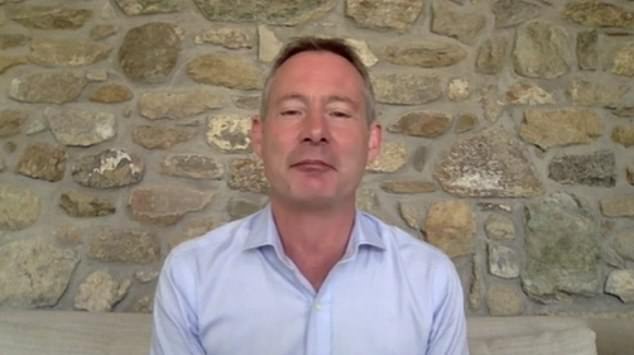
In statement, Tui's UK and Ireland managing director Andrew Flintham said: 'We want to be in the best position to provide excellent customer service, whether it's in a high street store, over the telephone or online, and will continue to put the customer at the heart of what we do'
The UK's biggest tour operator posted losses of 845.8 million euro (£747m) in the first half of 2020, compared to 289.1 million (£255m) in the same period 12 months previously
Ryanair said it suffered the 'most challenging' quarter in its 35-year history after carrying 500,000 passengers from April to June compared with 41.9million in the same period last year. Its share price fell 8 per cent in early trading this morning.
Meanwhile revenue collapsed from £2.1billion to £113million, with the Dublin-based carrier saying said a second wave of the disease was now its 'biggest fear'.
But chief financial officer Neil Sorahan told BBC Radio 4 that it would not cut flights to Spain, saying: 'As things stand, the market remains open, the schedules remain in place and we continue to operate in and out of Spain as normal.'
Speaking about the UK government advising against non-essential travel to Spain due to coronavirus, he told Reuters: 'I think it is regrettable, very disappointing.
'I have no doubt that we will see other localised outbreaks and we need to be flexible enough to deal with them as they arise over the next number of weeks and months.'
He added that the Spanish government has made clear that the country remained open for tourists, with infection levels low in much of the country.
'NO travel is risk free': Number 10 warns travellers that ANY country could be suddenly added to the quarantine list as Jet2 cancels all its Spanish holidays and travel firms warn of a wave of cancellations across France, Italy and Greece
Downing Street risked causing more confusion among British holidaymakers and travel firms, warning 'no travel is risk-free' amid fears of a wave of cancellations sparked by a shock U-turn on quarantine for arrivals from Spain.
No10 was unable to provide reassurances that the decision to subject people travelling from the popular holiday destination to 14 days in isolation - having previously cleared them to bypass the health restriction - would not be expanded to other countries with a coronavirus spike.
It comes as Jet2 cancelled all holidays to mainland Spain and the Spanish islands from tomorrow until August 16, following the same move from Tui.
Transport Secretary Grant Shapps tonight cut short his own Spanish holiday and will arrive back in the UK on Wednesday to start his own quarantine period, admitting it 'doesn't feel right' to be relaxing while others are suffering.
The Spain decision, which gave holidaymakers five hours' notice on Saturday, is believed to have spooked many people who had booked trips in France, Italy and Greece with operators already reporting 'lots of cancellations'.
A Ryanair spokesman said: 'The past quarter was the most challenging in Ryanair's 35-year history.
'COVID-19 grounded the group's fleet for almost four months (from mid-March to end June) as EU governments imposed flight or travel bans and widespread population lockdowns.
'During this time, group airlines repatriated customers and operated rescue flights for different EU governments, as well as flying a series of medical emergency/PPE flights across Europe.'
Flights were resumed on July 1, and the company said it aimed to operate around 40 per cent of its normal July schedule, increasing to 60 per cent in August and 70 per cent in September.
Meanwhile British Airways faced an 'immediate' strike threat from union bosses over job cuts amid fears over further travel chaos to families trying to plan a holiday abroad.
Unite leader Len McCluskey claimed BA chief executive Alex Cruz had 'published a timetable to fire and rehire thousands of your workforce on August 7'.
Mr McCluskey also told how MPs and newspapers alike have condemned the actions of the Spanish boss, adding: 'Perhaps you don't understand that the British sense of fair play runs deep in the psyche of the British people.'
It comes as the government advised against all but essential travel to Spain after the emergence of a second wave of coronavirus in parts of the country.
BA has so far used state furlough schemes, accessed £300million of UK government loans and retired its fleet of 747 jumbo jets earlier than planned.
The carrier, owned by International Airlines Group, has also gone on a huge job-cutting plan, having originally said it would axe up to 12,000 roles.
It struck a deal with its pilots union last week to make fewer people redundant - 270 down from plans for 1,250 redundancies - in return for other staff taking pay cuts.
However, sources close to the airline said it was false to say all BA staff face dismissal or will have to sign a new contract from August 7.
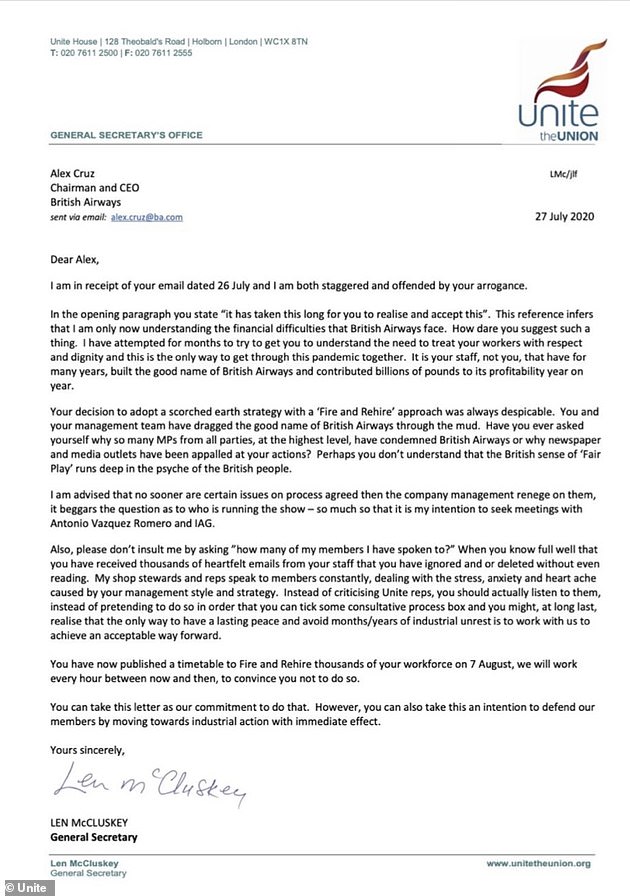
In the letter, Mr McCluskey said he had himself received a letter from Mr Cruz on Sunday but was 'both staggered and offended' by his arrogance.
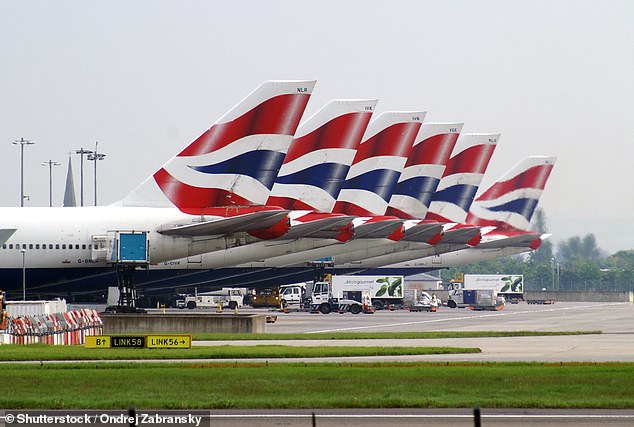
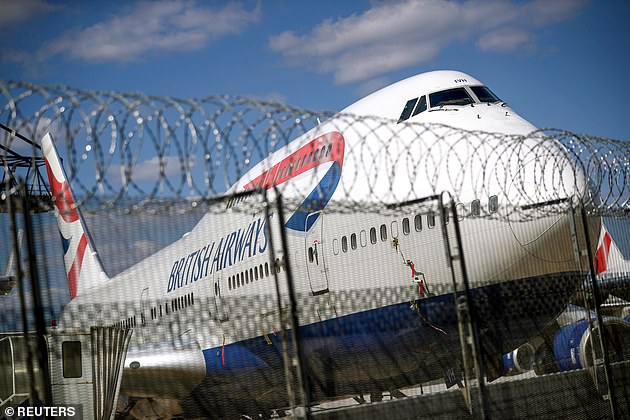
A fleet of British Airways Boeing 747 standing at London Heathrow Airport (file picture)
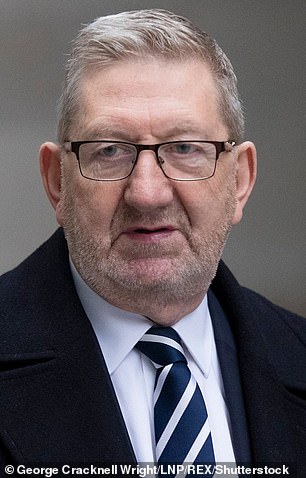
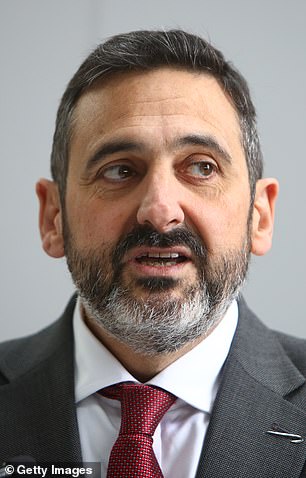
Unite leader Len McCluskey (left) wrote to British Airways chief executive Alex Cruz (right)
Airlines are refusing to cancel flights to Spain despite Government advising against all but essential travel
Airlines are refusing to cancel flights to Spain - despite the Government advising against all but essential travel.
The move puts hundreds of thousands of British families in limbo and at risk of losing thousands of pounds. It also puts the airline industry at odds with the UK Government by ignoring a public safety edict.
The Government issued the travel warning after the emergence of a second wave of coronavirus in parts of Spain.
Customers would normally expect travel firms to cancel the flights and offer refunds. But all the major carriers, which have suffered massive losses following the collapse of air travel, have snubbed the Government and continue to offer the flights.
This means families will potentially lose their holidays and their money.
People could ignore the Government and take their flights. But they would have to quarantine for 14 days when they get back and their travel insurance may be void.
Alternatively, they could cancel their trip without any guarantee of a refund. British Airways and easyJet have suggested they will offer vouchers for future flights, rather than a refund, for those who cancel.
Ryanair has refused to offer anything. It even suggested people who changed their flights could incur charges of up to £95 per person.
The Civil Aviation Authority said there was nothing it could do to ensure those with a flight-only booking got a refund. It suggested they claim money back from a travel insurance policy, but most insurers have clauses that reject any claims linked to coronavirus.
The union boss wrote: 'In the opening paragraph you state 'it has taken this long for you to realise and accept this'.
'This reference infers that I am only now understanding the financial difficulties that British Airways face. How dare you suggest such a thing.
'I have attempted for months to try to get you to understand the need to treat your workers with respect and dignity and this is the only way to get through this pandemic together.
'It is your staff, not you, that have for many years, built the good name of British Airways and contributed billions of pounds to its profitability year on year.'
Mr McCluskey added that Mr Cruz and his management team had 'dragged the good name of British Airways through the mud'.
The union leader continued: 'Have you ever asked yourself why so many MPs from all parties, at the highest level, have condemned British Airways or why newspaper and media outlets have been appalled at your actions?
'Perhaps you don't understand that the British sense of fair play runs deep in the psyche of the British people.'
Mr McCluskey added: 'My shop stewards and reps speak to members constantly, dealing with the stress, anxiety and heart ache caused by your management style and strategy.
'Instead of criticising Unite reps, you should actually listen to them, instead of pretending to do so in order that you can tick some consultative process box and you might, at long last, realise that the only way to have a lasting peace and avoid months/years of industrial unrest is to work with us to achieve an acceptable way forward.
'You have now published a timetable to fire and rehire thousands of your workforce on August 7. We will work every hour between now and then, to convince you not to do so.
'You can take this letter as our commitment to do that. However, you can also take this an intention to defend our members by moving towards industrial action with immediate effect.'
BA is currently operating 15 per cent of its normal schedule and losing £20million a day, with two of its biggest markets, the US and India, effectively closed.
A BA spokesman told MailOnline: 'For more than 100 years British Airways has been flying millions of people around the world. Today that world remains largely closed.
'This is the biggest challenge the airline and our industry has ever faced. Sadly, the global pandemic has resulted in job losses across every industry. Many airlines have already made thousands of staff redundant.
A British Airways Boeing 747 is seen at London Heathrow Airport earlier this month on July 17
'We are not immune to this crisis. We have to adapt to survive, so we will continue with the proper, lawful consultative process and we will keep inviting union representatives to discuss our proposals to the serious challenges we face.
'It is not too late to find solutions - as we have done with Balpa (British Airline Pilots Association) - and to protect jobs.'
It comes after £1.5billion was wiped off the value of Britain's leading travel companies as quarantine chaos and fears of a second wave of coronavirus infections shook markets.
Investors dropped shares in airlines and tour operators after the Government removed Spain from the quarantine-free list with just a few hours' notice.
Thousands of holidaymakers cancelled trips to Spain as well as countries such as France and Germany amid concerns they could be next.
In the letter, Mr McCluskey said he had himself received a letter from Mr Cruz on Sunday but was 'both staggered and offended' by his arrogance
The pandemic came at a time the industry was already strained due to concerns over fierce competition and low consumer confidence.
In March regional carrier Flybe went bust and in September last year Thomas Cook collapsed stranding 150,000 UK holidaymakers abroad.
Meanwhile, Richard Branson has controversially begged the British government for an emergency loan to rescue Virgin Atlantic from collapse. Virgin Australia has entered voluntary administration.
Countless holidays have been cancelled since the Foreign Office advised against all but essential travel in March.
With no end date in sight, and the Government now looking to enforce a 14-day quarantine period for travellers returning to Britain by air, it is highly likely that many families will be unable to go abroad for the foreseeable future.
Despite this, scores of readers told Money Mail they are still being asked to pay more money for trips they are certain they won't be able to take.
At least 66,102 jobs are at risk across the UK amid the ongoing coronavirus crisis
Below is a table showing how many jobs are at risk in British businesses
Dyson - 600
Southbank Centre - 400
DFS Furniture - 200
Centrica - 5,000
Johnson Matthey - 2,500
Accenture - 900
Airbus - 1,700
Arcadia - 500
BA - 12,000
Beales - 1,052
Bentley - 1,000
Burberry - 150 at risk
Burger King - 1,600
Casual Dining Group (Bella Italia, Cafe Rouge and Las Iguanas) - 1,900
DHL at Jaguar Land Rover - 2,200
EasyJet - 4,500
Go Outdoors - 2,400
The Guardian - 180 at risk
BBC - 520
Harrods - 700
Harveys - 240
Links - 350
Mothercare - 2,500
Oasis Warehouse - 1,800
P&O Ferries - 1,100
Pret a Manger - 1,330
Ryanair - 3,000
Skyscanner - 300 (84 in Edinburgh)
Upper Crust, Caffe Ritazza - 5,000
Ted Baker - 160
TM Lewin - 600
Tui - 8,000
Victoria's Secret - 800 at risk
M&S - 950
Selfridges - 450
Matt Hancock denies talking up COVID panic by claiming a 'second wave is rolling across Europe' as he defends increase in self-isolation time to TEN days for people testing positive or showing symptoms
By Martin Robinson Chief Reporter and Stephen Matthews Health Editor for MailOnline
Matt Hancock today denied stoking up Covid-19 panic and hysteria after he warned a second wave was 'starting to roll across Europe' towards Britain and declared there was a 'real danger' of the UK being struck by a spike in cases.
Ministers today confirmed people who now test positive for coronavirus or have tell-tale symptoms will be told to stay at home for ten days, in line with World Health Organization guidance — up from the current seven-day self-isolation period because 'evidence has strengthened'.
It came hours after it emerged that Boris Johnson — who fears a second wave could strike Britain within a fortnight — told his SAGE advisers and cabinet ministers that he 'needs to act fast' and is expected to ramp up quarantine measures at home and abroad within days.
Today BBC broadcaster Nick Robinson repeatedly asked Mr Hancock if he was being hysterical about rising cases in Europe and the UK because infection rates are nowhere near the lockdown peak and are likely to be a symptom of society returning to a new normal. Mr Robinson also asked if he was overreacting because of a fear of repeating mistakes Number 10 made at the start of the outbreak, such as not quarantining travellers from abroad.
The Health Secretary said: 'No, it's not [risking hysteria]. I'm the Health Secretary in the middle of the pandemic. We are absolutely determined to protect this country and it saddens me we are seeing these rises elsewhere but I will be vigilant and we will move fast if we need to because that is what the virus requires and the virus moves fast and so must we.'
Labour MP Chris Bryant today called for ministers to calm down, saying 'we need a stiletto not a sledgehammer' to tackle clusters of coronavirus. He said: 'It makes me so angry the government are so loose with their language. There isn’t a second wave rolling out across Europe. There are worrying signs of individual spikes of increased infection in some areas.'
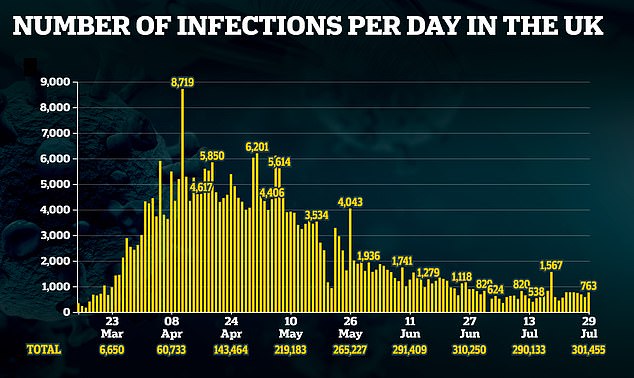
Britain announced another 763 new coronavirus cases yesterday, up 14 per cent in a week — but way below the 5,000 new cases per day that were being recorded at the high of the outbreak. Cambridge University academics believe outbreaks are getting bigger in the stay-cation hotspots of the South West and South East of England but are only slightly worse.
Top scientists today admitted it is unlikely the coronavirus will ever be eradicated, saying it could be around for decades and infect people 'multiple times over their life span'. Critics argued that Britain needs to 'learn to live with it' because the virus is going to keep spreading.
Business leaders reacted warily to the prospect of tighter restrictions being introduced over the rise in cases, with firms saying it is 'vital' economies crippled by coronavirus-controlling policies begin the process of recovery this summer ahead of an expected resurgence later this year.
Matt Hancock's second wave warning came as:
- Boris Johnson told advisers Britain 'needs to act fast' to avoid second wave — with more holiday destinations set to be added to UK quarantine list tomorrow;
- Sir Patrick Vallance and Professor Chris Whitty want tougher border controls immediately after figures show 1,300 people with Covid-19 entered the UK at the start of the pandemic;
- England had the highest level of excess deaths in Europe over the coronavirus pandemic, according to data from the Office for National Statistics;
- Leicester's lockdown will be reviewed today — 48 hours earlier than expected as official statistics show the city's coronavirus infection rate has halved in a fortnight;
- Up to 21,000 people have died because of unintended consequences of lockdown – many due to a lack of access to healthcare, according to a shocking study.
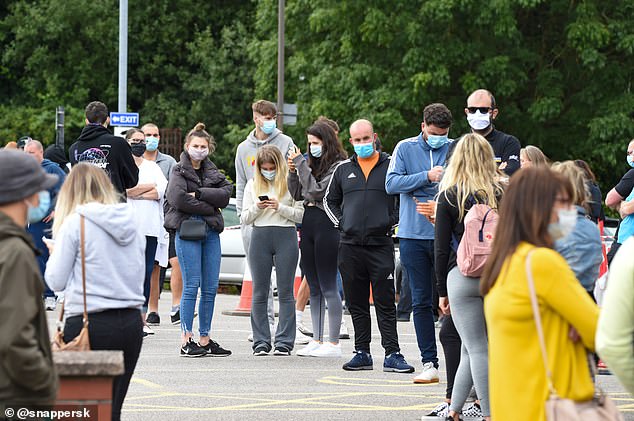
Patients who are confirmed to have Covid could be told to stay at home for 14 days under a change to the rules. Pictured: People queue up at a walk-in Covid-19 testing centre at Crown Street car park in Stone, Staffordshire after nearby Crown and Anchor pub saw outbreak of the disease
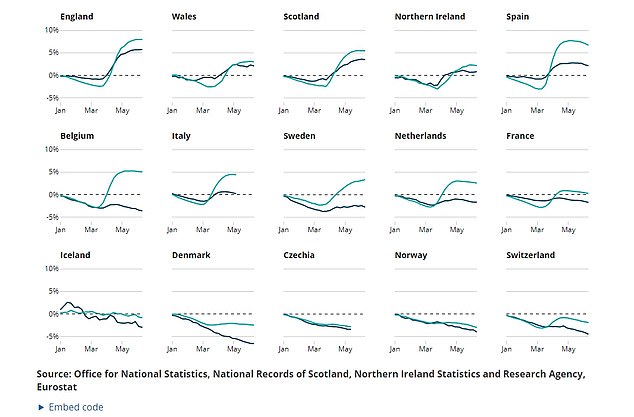
ENGLAND SUFFERED THE MOST EXCESS DEATHS IN EUROPE DURING THE COVID-19 PANDEMIC
England had the highest level of excess deaths in Europe over the coronavirus pandemic, new figures revealed today.
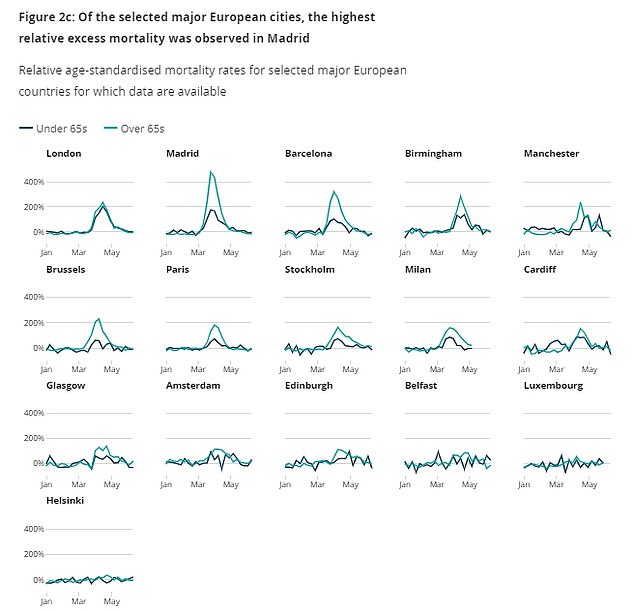
By the end of May, England had seen the highest overall excess deaths — fatalities from all causes that are above the level that would normally be expected — out of 21 European countries compared by the Office for National Statistics.
While other countries had higher spikes in excess deaths between February and June, England had the longest continuous period of elevated mortality rate - meaning it had the highest level of excess deaths overall.
Excess deaths include fatalities from all causes, but they can be used as evidence of how severe coronavirus outbreaks have been - because not all deaths caused by the virus are recorded by authorities.
It was Spain and Italy that suffered the largest spikes in excess deaths, called 'peaks', suggesting they faced the hardest hits on the continent.
Bergamo, one of the first places in Europe to go into lockdown, had the highest peak in excess mortality. It saw 847.7 per cent more deaths than usual in the week ending 20 March.
The UK's highest peak of excess deaths was recorded in Brent, at 357.5 per cent at the height of Britain's crisis, in the week ending 17 April.
Covid-19 cases in Britain rose again yesterday, with the Department of Health announcing another 763 people tested positive for the virus, taking the rolling seven-day average to 726.
In comparison, the rate was 697 yesterday, 638 last Wednesday and has been on the up for a fortnight amid fears of a resurgence.
However, the number of coronavirus deaths has barely changed in the past 10 days, with the rolling seven-day average currently standing at 66. For comparison, it was 65 on Tuesday and 64 last Wednesday.
Infected patients can take weeks to die from the coronavirus, meaning any up-tick in cases across the past fortnight may not start trickling through until next week.
It comes as Number 10 today confirmed the length of time people with coronavirus symptoms in England will have to self-isolate for is to be increased to 10 days.
Patients who are confirmed to have Covid or who have a cough, fever or loss of sense of smell or taste were told before to stay at home for seven days.
Deputy chief medical officer Professor Jonathan Van-Tam told reporters the change was being made due to the 'low but real possibility of infectiousness' between seven and 10 days after the onset of the illness.
Health officials still believe there is evidence shows people with symptomatic coronavirus are most infectious just before and in the days immediately after their symptoms appear.
However, there is also a low but tangible possibility that people with Covid-19 are still infectious between seven and nine days after their symptoms start, which prompted the change in guidance today.
Health chiefs stressed the previous advice was 'seven days minimum' rather than just seven days, with people whose symptoms persisted longer advised to remain in isolation for longer.
Mr Hancock also hinted more European countries could be added to the UK's quarantine list to stop Covid-19 getting a stranglehold in Britain again, after ministers were accused of being too slow to react early on in the pandemic.
He told Sky News: 'I am worried about a second wave. You can see a second wave starting to roll across Europe. We have to do everything we can to prevent it reaching these shores.
By the end of May, England had seen the highest overall relative excess mortality out of 21 European countries compared by the Office for National Statistics. But the hardest hit nations were Italy and Spain which suffered the largest spikes
Looking at major cities, the highest peak excess mortality was in Madrid at 432.7 per cent in the week ending March 27. Meanwhile in the UK, Birmingham had the highest peak excess mortality of any major British city at 249.7 per cent in the week ending April 17
CORONAVIRUS R RATE 'IS ABOVE DREADED LEVEL OF ONE IN SOUTH WEST AND SOUTH EAST'
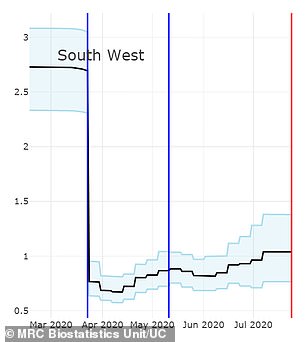
The coronavirus R rate is above the dreaded level of one in the South West and South East of England, according to a projection.
Government scientists say the UK's reproduction number — the average number of people each Covid-19 patient infects — is still between 0.7 and 0.9.
But a team from Cambridge University estimate it could be above one in two regions, and on the brink of passing the level in every part of the country except the Midlands.
It is vital this number stays below one, otherwise the coronavirus outbreak could start to rapidly spiral again as people infect others around them at a faster rate.
Academics analyse figures on deaths and cases, as well as data on how many people have antibodies and social interactions, to make their predictions that feed into SAGE.
According to their model, the R rate is the highest in the South West (1.04) — home to the stay-cation hotspots of Cornwall, Devon and Dorset. It is also estimated to be above one in the South East (1.02).
Three other regions — the North West, East and London — have seen a rise in the reproduction rate, which experts say is not an accurate way to measure an outbreak when cases are low.
Scientists blamed the the lifting of lockdown measures, the Daily Telegraph reports. Infectious disease academics warned a spike would be inevitable.
'It's not just Spain, there are other countries too where the number of cases is rising, and we are absolutely determined to do all we can to keep this country safe.'
He told the BBC later: 'There is a real danger of an increase in cases in the UK but we will move fast if needed'.
The quarantine period for people returning to the UK from foreign countries such as Spain would be pared back to 10 days with testing from 14 days under the same plans, it was claimed today.
Isolation rules have previously caused confusion as those confirmed to have the virus via a test have been told to isolate for seven days, whereas their 'close contacts' faced 14 days. The disparity was due to the time taken to develop symptoms of the virus.
The Government has at times been accused of 'mixed messaging' over the rules.
The policy change came after talks between Sir Patrick Vallance, the government's chief scientific adviser, Boris Johnson and senior cabinet ministers at No 10 on Monday.
Mr Johnson is said to have told them: 'We need to act fast' with a ramping up of quarantine rules expected within 24 hours.
The Government's Chief Scientific Adviser Sir Patrick Vallance warned No10 that Britain could be just two or three weeks behind Spain's second wave trajectory, according to The Times.
But experts have called on ministers not to over-react to the small spike in cases.
Professor Paul Hunter, an infectious disease expert at the University of East Anglia, told MailOnline: 'I do not think we will ever eradicate the virus. I think it is likely that the virus will be around for decades and infect people multiple times over their life span.
'However, because of residual immunity from prior infections or immunization, the disease will become far less severe and probably start to resemble to common cold.
He added: 'A country like New Zealand that has eradicated the virus will only get infected when they open up again, as they will eventually have to do.'
Professor Keith Neal, from the University of Nottingham, told MailOnline: 'We need to learn to live with it, the virus is going to keep spreading and causing spikes or clusters unless we keep restrictions or get a vaccine.
'We may get small resurgences when people’s behaviour gets more lax, but we can tighten restrictions in these hotspots, look at Leicester – disease is falling.'
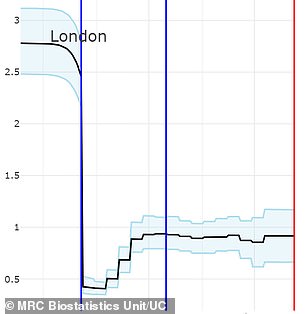
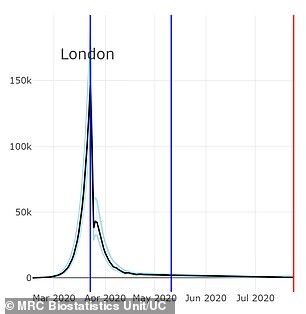
Modelling from Cambridge University suggests the R rate (left) has barely changed in London and now stands at 0.92, after dropping to below 0.5 after the lockdown was introduced. The team also believes cases (right) are on the decline and have not yet to spike upwards in the capital. The first blue line is March 23, when lockdown was introduced. The second blue line is May 11, when the government released its Covid-19 recovery strategy. The red line is July 24, the last day of modelling
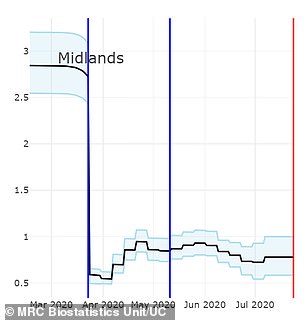
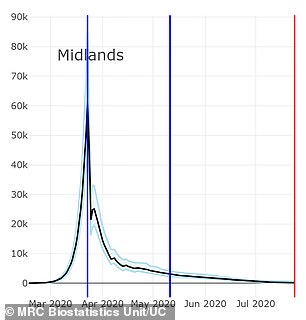
The coronavirus R rate in the Midlands (left) is much lower than it was in June, according to the Cambridge team. Cases (right) are also still declining but at a much slower rate than they were
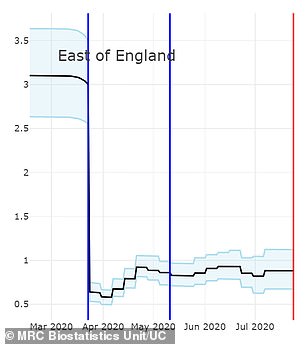
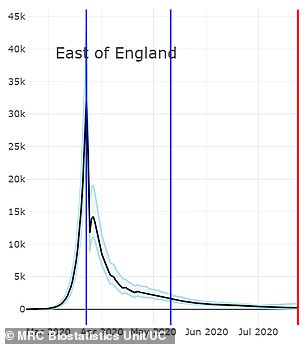
The R rate in the East of England (left) now stands at 0.88, but has barely changed throughout July. The number of daily cases (right) is also still on a downward trend, according to the academics
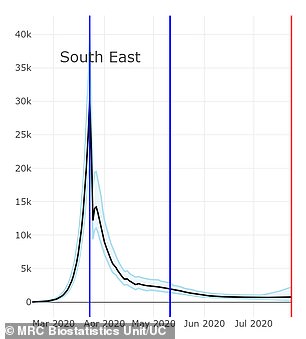
However, the R rate appears to have risen above one in the South East (right) and cases (right) are starting to float upwards — from an estimated 669 infections on July 6 to 758 on July 24
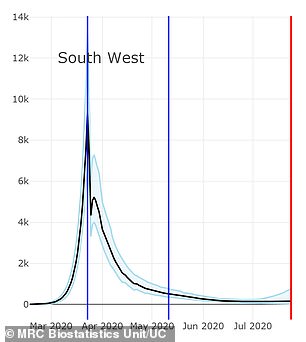
The R rate (left) is also estimated to have risen to above one in the South West, the region home to Devon, Cornwall and Dorset. The team estimated there were 160 new infections across the region on July 24 — up from 136 on July 4
ARE CASES ON THE UP IN BRITAIN?
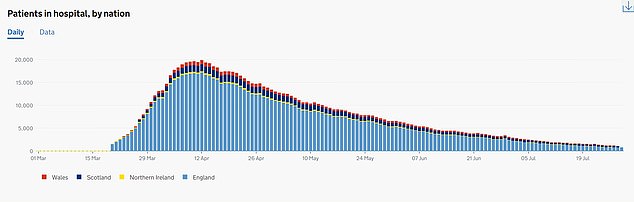
Coronavirus cases in Britain have been on the up for a fortnight — but deaths have barely changed and hospital admissions are still flat, according to official figures.
Department of Health statistics show 726 people are testing positive for the life-threatening virus each day, on average. It is 33 per cent higher than the average of 546 recorded exactly three weeks ago, which was the lowest figure since before lockdown.
But the number of Brits being diagnosed with Covid-19 is much lower than what was being recorded during the darkest days of the outbreak in April.
Around 5,000 positive tests were being recorded each day during the height of the crisis — but this is likely to be a massive under-estimate due to a lack of testing. Fewer than 20,000 people were getting swabbed for the virus on a daily basis in April. Now more than 100,000 tests are being processed each day.
The number of coronavirus deaths has barely changed in the past 10 days, with the rolling seven-day average currently standing at 66. For comparison, it was 65 on Tuesday and 64 last Wednesday.
Infected patients can take weeks to die from the coronavirus, meaning any up-tick in cases across the past fortnight may not start trickling through until next week.
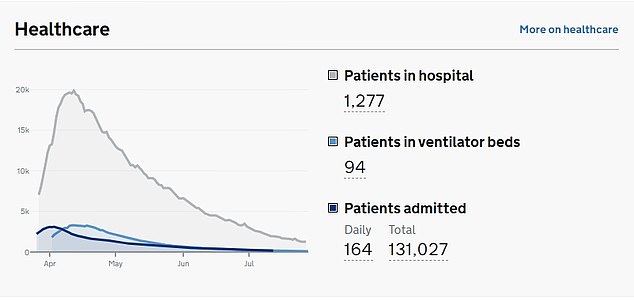
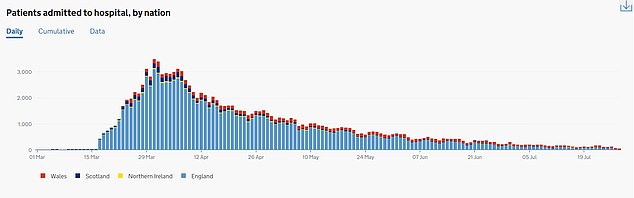
Hospital admissions — another marker of an outbreak that go up before deaths — have also barely changed in the past week. Fewer than 100 people are still being admitted in England each day.
However, scientists from King's College London believe cases could still be on the rise. Data from a symptom-tracking app the team runs estimates 2,110 people are being struck down with the virus each day in the UK — up from 1,884 last week. But the academics believe the outbreak is stable.
Testing figures do not show the true number of people infected because many people catch the virus but never test positive for it, either because they don't realise they are sick, because they couldn't get a test, or because their result was wrong.
He added the UK can live alongside the virus and keep transmission risk to as low as possible 'by mask wearing, working from home, travel restrictions, taking appropriate actions in hotspots'.
Professor Neal said: 'You’re always going to have hotspots, like Leicester and in Spain. But every measure helps reduce transmission trails.'
The rolling average of daily cases in the UK has been rising since earlier this month, while there have been fresh restrictions in Oldham, Greater Manchester, and localised outbreaks in Stone, Staffordshire, and Wrexham, north Wales.
Figures yesterday revealed Oldham had overtaken Leicester to have the England. Blackburn with Darwen is still the worst-hit authority in the country.
But NHS data today shows it is back down in third place, with an infection rate of 53.1 cases per 100,000 people during July 21 to 27.
Leicester's rate currently stands at 57.7 — up slightly on Wednesday's figure but down 15 per cent in a week.
Leicester, the first place in the UK to have a mini-lockdown imposed, will have its shutdown reviewed today — two days earlier than expected.
Fears of a resurgence of infections come as scientists found that the coronavirus R rate is above the dreaded level of one in the South West and South East of England.
Government scientists say the UK's reproduction number — the average number of people each Covid-19 patient infects — is still between 0.7 and 0.9.
But a team from Cambridge University estimate it could be above one in two regions, and on the brink of passing the level in every part of the country except the Midlands.
It is vital this number stays below one, otherwise the coronavirus outbreak could start to rapidly spiral again as people infect others around them at a faster rate.
Academics analyse figures on deaths and cases, as well as data on how many people have antibodies and social interactions, to make their predictions that feed into SAGE.
According to their model, the R rate is the highest in the South West (1.04) — home to the stay-cation hotspots of Cornwall, Devon and Dorset. It is also estimated to be above one in the South East (1.02).
Three other regions — the North West, East and London — have seen a rise in the reproduction rate, which experts say is not an accurate way to measure an outbreak when cases are low.
Scientists blamed the the lifting of lockdown measures, the Daily Telegraph reports. Infectious disease academics warned a spike would be inevitable.
Despite the warnings, Boris Johnson was urged not to panic over fears of a summer surge.
STOP FOREIGN TRAVEL TO ELIMINATE COVID-19, SCIENTISTS SAY
Banning foreign travel could eliminate Covid-19 and give Britain the 'best chance' of achieving Boris Johnson's pledge of returning to normal life by Christmas, top scientists have said.
Epidemiologists Professor David Hunter and Professor Neil Pearce believe the virus can be wiped out but would need ministers to 'change course'.
In a comment piece in The Guardian today, the pair said: 'Encouraging travel abroad in the middle of a pandemic makes no epidemiological sense.
'With every arriving overseas visitor or returning holidaymaker, the risk of bringing Covid-19 into the country increases.
'The government has so far justified allowing this travel because it believes community transmission of the virus in the UK is inevitable until a vaccine arrives. It is not.'
Professor Hunter, of Oxford University, and Professor Pearce, of the London School of Hygiene and Tropical Medicine, added: 'If we want to avoid a “November nightmare” and have a relatively “normal” Christmas, a push for elimination gives us the best chance.
'Is elimination achievable? We think it is – though it would require major changes to the British government’s current thinking.'
In a call to action this week, Scotland's first minister Nicola Sturgeon called on the UK to work together to 'eliminate' the coronavirus rather than letting it 'hover around'.
The Independent SAGE group, led by former chief scientific adviser for England, Sir David King, has also backed calls for a 'Zero Covid UK'.
But leading scientists have warned the goal is unachievable, with the government's own chief scientific adviser Sir Patrick Vallance last month telling MPs it will be around 'for a number of years'.
Former Conservative leader Sir Iain Duncan Smith said ministers should continue efforts to get the economy moving by urging more workers to return to the office. He said: 'The message from the Government is still really fearful, it needs to be much more nuanced.
'They must say, 'Look, this is a disease that by-and-large affects those with co-morbidities. Protect the vulnerable but the rest of you should be getting back to work'.' Sir Iain added: 'We seem to have lost the ability to balance risk.'
Meanwhile, health leaders said there were 'very high' levels of concern about a fresh spike.
Niall Dickson, chief executive of the NHS Confederation, told the All-Party Parliamentary Group on Coronavirus that non-Covid productivity in NHS trusts was currently at about 60 per cent.
He called for an 'Amazon-style' way for health and care workers to order personal protective equipment where it arrives the next day.
Dr Chaand Nagpaul, chairman of the council of the British Medical Association, said another spike should not be seen as an 'inevitability' and it was time to be 'more robust' about mitigating the threat.
He also called for more concise public messaging over measures people can take to stop the spread of the virus.
'If I look even at something as simple as our messages on social distancing we're told that social distancing is still two metres, or one metre plus,' he said.
'Do you think any member of the public understands what one metre plus means? What does the plus mean? Many don't really understand this because it's not clear and they're not social distancing.
It comes as damning figures today revealed England had the highest level of excess deaths in Europe over the coronavirus pandemic.
By the end of May, England had seen the highest overall excess deaths — fatalities from all causes that are above the level that would normally be expected — out of 21 European countries compared by the Office for National Statistics.
While other countries had higher spikes in excess deaths between February and June, England had the longest continuous period of elevated mortality rate - meaning it had the highest level of excess deaths overall.
Excess deaths include fatalities from all causes, but they can be used as evidence of how severe coronavirus outbreaks have been - because not all deaths caused by the virus are recorded by authorities.
It was Spain and Italy that suffered the largest spikes in excess deaths, called 'peaks', suggesting they faced the hardest hits on the continent.
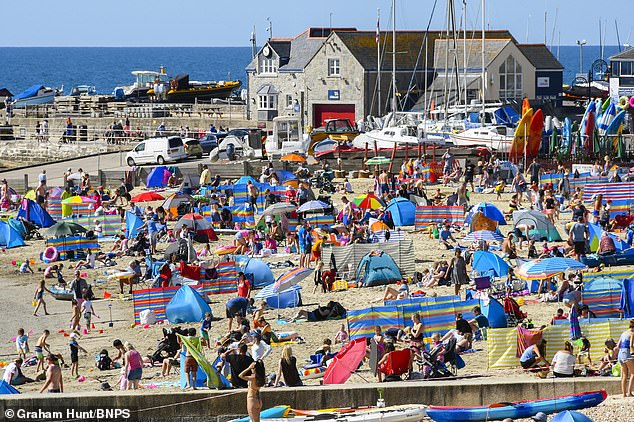
Sunbathers and holidaymakers flock to the beach at the Dorset seaside resort of Lyme Regis today to enjoy the scorching weather
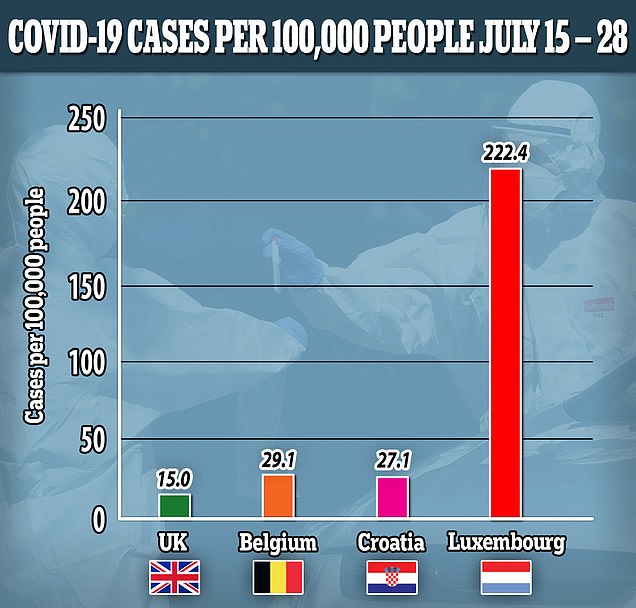
Belgium and Luxembourg could be removed from the safe travel list as early as tomorrow and Croatia could also be at risk. Luxembourg has the highest incidence of coronavirus cases per 100,000 people in Europe
YOUNGER PEOPLE 'MAY BE MORE AT RISK IN A SECOND WAVE'
Younger people could be more at risk of getting coronavirus if the predicted second wave hits the UK this winter, it was also claimed today.
The president of the Royal Society of Medicine warned that the second wave is 'almost certainly coming this winter' and could be very different from the first.
Professor Roger Kirby's warning comes as Boris Johnson revealed a second wave could begin in as little as two weeks. Speaking on BBC Radio 4 this morning, retired surgeon Professor Kirby said: 'The winter is coming and almost certainly a second wave of this virus is coming.
'What we saw in 1918 was the virus change and the second wave was different from the first wave and it affected a different group of people - particularly younger people.'
His theory is based on a similar series of events which happened during the Spanish flu epidemic in the early 1900s and killed 50 million people across the world.
It broke out in March 1918 and mainly affected the older and sickly people during World War I. The pandemic seemed to come to an end in August 1918 but death rates spiked again between September and November.
However, the virus had turned into a new strain which could effect young and healthy people.
Bergamo, one of the first places in Europe to go into lockdown, had the highest peak in excess mortality. It saw 847.7 per cent more deaths than usual in the week ending 20 March.
The UK's highest peak of excess deaths was recorded in Brent, at 357.5 per cent at the height of Britain's crisis, in the week ending 17 April.
Two top scientists today said that banning foreign travel could eliminate Covid-19 and give Britain the 'best chance' of achieving Boris Johnson's pledge of returning to normal life by Christmas.
Epidemiologists Professor David Hunter and Professor Neil Pearce believe the virus can be wiped out but would need ministers to 'change course'.
In a comment piece in The Guardian today, the pair said: 'Encouraging travel abroad in the middle of a pandemic makes no epidemiological sense.
'With every arriving overseas visitor or returning holidaymaker, the risk of bringing Covid-19 into the country increases.
'The government has so far justified allowing this travel because it believes community transmission of the virus in the UK is inevitable until a vaccine arrives. It is not.'
Professor Hunter, of Oxford University, and Professor Pearce, of the London School of Hygiene and Tropical Medicine, added: 'If we want to avoid a “November nightmare” and have a relatively “normal” Christmas, a push for elimination gives us the best chance.
'Is elimination achievable? We think it is – though it would require major changes to the British government’s current thinking.'
Younger people could be more at risk of getting coronavirus if the predicted second wave hits the UK this winter, it was also claimed today.
The president of the Royal Society of Medicine warned that the second wave is 'almost certainly coming this winter' and could be very different from the first.
Professor Roger Kirby's warning comes as Boris Johnson revealed a second wave could begin in as little as two weeks.
Speaking on BBC Radio 4 this morning, retired surgeon Professor Kirby said: 'The winter is coming and almost certainly a second wave of this virus is coming.
'What we saw in 1918 was the virus change and the second wave was different from the first wave and it affected a different group of people - particularly younger people.'
His theory is based on a similar series of events which happened during the Spanish flu epidemic in the early 1900s and killed 50 million people across the world.
It broke out in March 1918 and mainly affected the older and sickly people during World War I. The pandemic seemed to come to an end in August 1918 but death rates spiked again between September and November.
However, the virus had turned into a new strain which could effect young and healthy people.
Experts now fear that coronavirus could see a similar 'W curve' as the Spanish flu - meaning there would be three major spikes in deaths.
Who’s afraid of a second wave? That’s what Boris fears. But as ROSS CLARK points out, the figures just don’t add up – and besides, from treatment to vulnerability, so much has changed since March
For too many months city centres across Britain have resembled ghost towns.
So the slow awakening in recent weeks, as shops, hair salons, pubs, cafes and restaurants began to reopen, has been a huge morale boost.
The economy might be on life support but there was hope.
Buoyed by this and desperate for a break, tens of thousands of us began flying off to the sun. Family holidays were no longer a lockdown fantasy but a real possibility.
And then suddenly this week the mood changed again.
Prime Minister Boris Johnson has warned that the UK faces a threat of ‘a second wave in other parts of Europe’ and in the UK within a fortnight after a 28 per cent increase in Covid cases since the start of the month
On Saturday, holidaymakers returning from Spain were ordered into a 14-day quarantine after a spike in coronavirus cases in the country. And we were warned that similar measures may be applied to other popular destinations.
The Prime Minister went further, warning that we face a threat of ‘a second wave in other parts of Europe’ and in the UK within a fortnight after a 28 per cent increase in Covid cases since the start of the month.
That term — ‘second wave’ — will have struck terror into the hearts of many, taking them back to early spring when the daily death toll was in the high hundreds, rising to more than 1,000 deaths a day at the peak in late April.
But is Boris Johnson really justified in using such an emotive term?
It is true that over the past four weeks Spain has seen an increase in numbers of confirmed Covid cases, as you would expect with the easing of lockdown —almost 14,000 new cases to July 26.
Yet it hasn’t suffered even a slight upwards nudge in the number of deaths — as would be likely if there were a genuine second wave.
Just six people have died from Covid-19 in Spain in the past week — compared with over 900 a day at the height of the epidemic in April.
Moreover, there is a problem in using the number of recorded cases as a sign of a second wave, given that the more we test, the greater the number of cases recorded. And the rise is largely restricted to North-East Spain, especially Catalonia.
So is it possible Spain’s ‘second wave’ could be little more than a statistical illusion?
Since May 10, the country’s daily figures for new cases of Covid-19 have included those diagnosed through antibody tests, which tell you whether you have been exposed to the disease in the past.
In other words, someone who shows up as a ‘new’ case in Spain today could actually have contracted the infection months ago.
In Britain, by contrast, daily figures for new Covid-19 infections include only people who currently have the disease.
This is just one reason among several that leaves some scientists less than impressed by the Prime Minister’s inflammatory use of ‘second wave’.
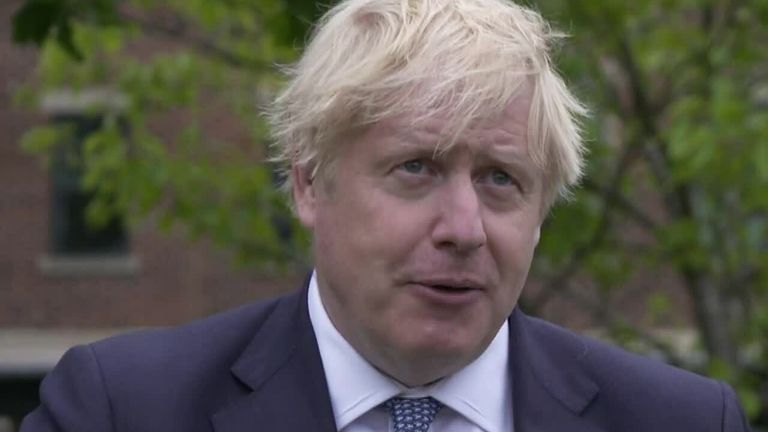
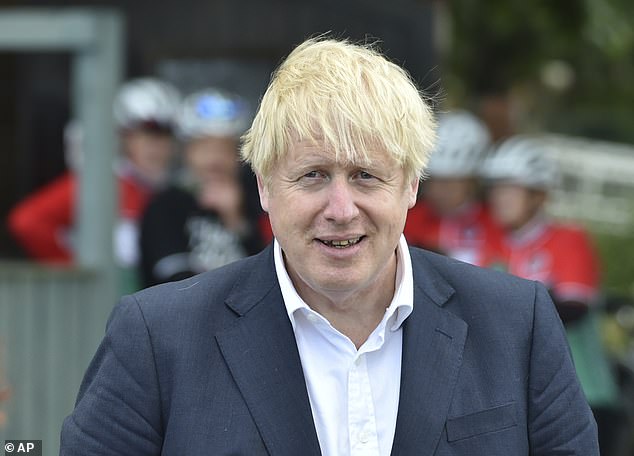
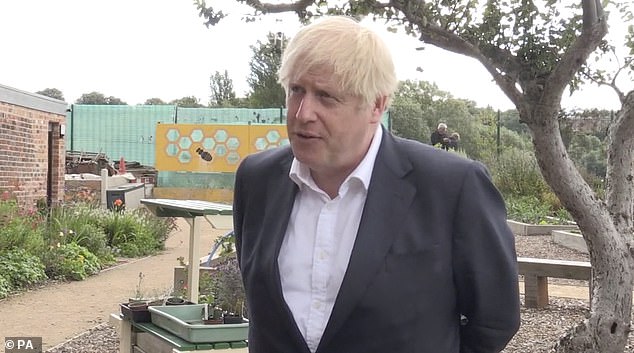
Boris Johnson pictured on a visit to Nottingham on Tuesday where he expressed fears over a second Covid-19 onslaught
According to Linda Bauld, a professor in public health at Edinburgh University, ‘what we are seeing now [in parts of Europe] is essentially localised spikes’, while Paul Hunter, a professor in infectious diseases at the University of East Anglia, says it would take two weeks of a rising number of cases before we need to start panicking.
But even if we do suffer a resurgence of Covid-19, now or in the autumn or winter, there is growing evidence it won’t be as bad as the first wave for the following reasons:
Test and Trace: Health Secretary Matt Hancock’s ‘world-beating’ track and trace phone app might have disappeared without trace after its trial on the Isle of Wight, but we do now have a manual test and trace system in operation.
In spite of teething troubles which left some of the 25,000 staff running the system complaining of having nothing to do, it is working.
In the week to July 15, for example, 355,597 tests were carried out in England and 3,953 people tested positive.
Of these, 3,098 were contacted and 13,034 of their close contacts told to self-isolate for 14 days — although no one knows how many of them did.
It might be far from perfect, but it is better than at the height of the epidemic when people with mild symptoms were told not to bother the NHS — and consequently had no idea whether they had the virus or not.
Social Distancing: It is fast becoming a way of life for millions of Britons and will stop the virus spreading so quickly. Mask wearing, handwashing and the liberal use of sanitiser are also factors.
Far fewer people are travelling cheek by jowl on public transport, too. Compared with early March, rail travel has fallen by 80 per cent, Tube journeys by 76 per cent, London bus journeys by 55 per cent and bus journeys outside London by 69 per cent.
Fewer deaths: Fewer of us are as susceptible to the coronavirus now.
According to Public Health England’s latest estimate, 6.5 per cent of England’s population (almost 3.7 million) have antibodies to the Covid-19 virus, indicating they are likely to be immune to further infection.
Many more of us could have some degree of resistance to infection.
Growing evidence suggests exposure to other coronaviruses, some of which cause the common cold, may offer some degree of protection, reducing symptoms if not protecting us altogether.
Moreover, at the peak of the epidemic in April, many people were dying in care home outbreaks caused by NHS patients being discharged to the homes without being tested.
It was one of the Government’s greatest acknowledged failings and the same mistake is unlikely to be made again.
We are also better informed about those at greatest risk — people from Black, Asian, and Minority Ethnic backgrounds, diabetics, the obese and frontline workers. Steps will be taken to protect them faster.
Sadly, many of those most vulnerable to the virus — the very elderly, and those with serious underlying heart and lung ailments — have already succumbed to Covid-19.
Better treatment: In the initial stages of the pandemic, there was a rush to boost the supply of ventilators to the NHS in the belief that this was the only effective treatment for people with the most serious symptoms.
Since then, doctors have learned that administering oxygen via a mask — the treatment Boris Johnson received in ICU at St Thomas’ Hospital — is often more effective.
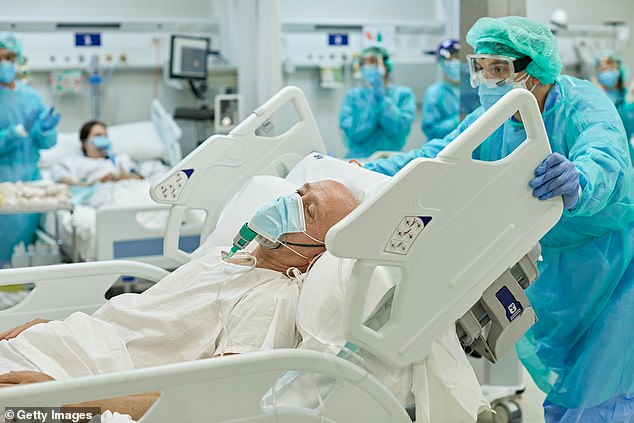
In the initial stages of the pandemic, there was a rush to boost the supply of ventilators to the NHS in the belief that this was the only effective treatment for people with the most serious symptoms
Proning — lying patients on their stomachs to assist oxygenation of the blood — has also proved a simple but effective technique to help seriously ill patients.
And in June, a team from Oxford University found that a cheap, readily available anti-inflammatory drug, dexamethasone, can reduce death rates among those on ventilators by a third, and among those on oxygen by 20 per cent.
(It doesn’t help people with mild symptoms.)
Increased data: The Government now has access to data which should allow it to identify places where the disease is accelerating and to impose localised restrictions to stop it spreading — just as happened in Leicester earlier this month and currently in Oldham.
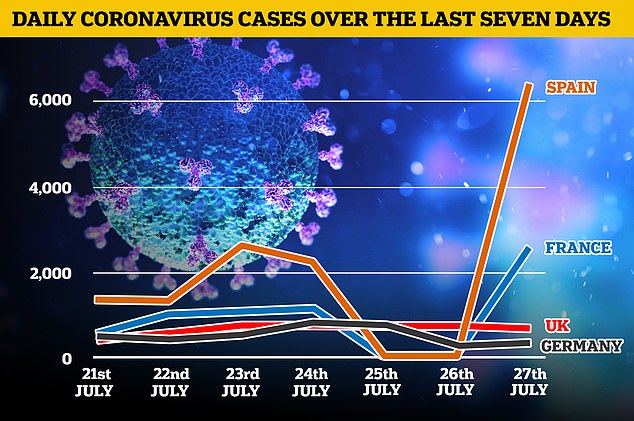
The most up to date figures show the number of new cases is rocketing upwards in Spain. It announced 6,361 new cases over the weekend, up from 4,581 the previous weekend. France announced 2,551 new coronavirus cases on Monday
Moreover, we now have quarantine in place for travellers arriving from other countries — something which didn’t exist in January and February.
Warm weather: Many viruses degrade in warm weather, which is why diseases such as flu tend to be seasonal. Covid-19 seems no different.
In March virologists at the University of Maryland in the U.S. mapped outbreaks of the disease and found they were concentrated where average temperatures were between 5c (41f) and 11c (52f) and average humidity between 47 and 79 per cent — which put Britain in the firing line in early spring.
All in all, while we cannot for a moment relax our guard when it comes to this novel coronavirus, there are reasons to be, if not cheerful, then at the very least, hopeful.
https://news.google.com/__i/rss/rd/articles/CBMigwFodHRwczovL3d3dy5kYWlseW1haWwuY28udWsvbmV3cy9hcnRpY2xlLTg1NzYwNjEvVHJhdmVsLWdpYW50LVR1aS1hbm5vdW5jZXMtY2xvc3VyZS0xNjYtaGlnaC1zdHJlZXQtc3RvcmVzLVVLLVJlcHVibGljLUlyZWxhbmQuaHRtbNIBhwFodHRwczovL3d3dy5kYWlseW1haWwuY28udWsvbmV3cy9hcnRpY2xlLTg1NzYwNjEvYW1wL1RyYXZlbC1naWFudC1UdWktYW5ub3VuY2VzLWNsb3N1cmUtMTY2LWhpZ2gtc3RyZWV0LXN0b3Jlcy1VSy1SZXB1YmxpYy1JcmVsYW5kLmh0bWw?oc=5